
When parents compare Avocado Health vs. ChatGPT, the difference comes down to one thing: safety. ChatGPT does not know your child, forgets every conversation, and gets medical questions wrong more often than you think. Avocado Health was built specifically for parents. It remembers your child, checks in proactively, and uses only pediatric expert-reviewed sources to keep your family safe.
Here is exactly how Avocado Health compares to ChatGPT and Google, and why the difference matters for your family.
Table of Contents
Why Do So Many Parents Use ChatGPT for Parenting Questions?
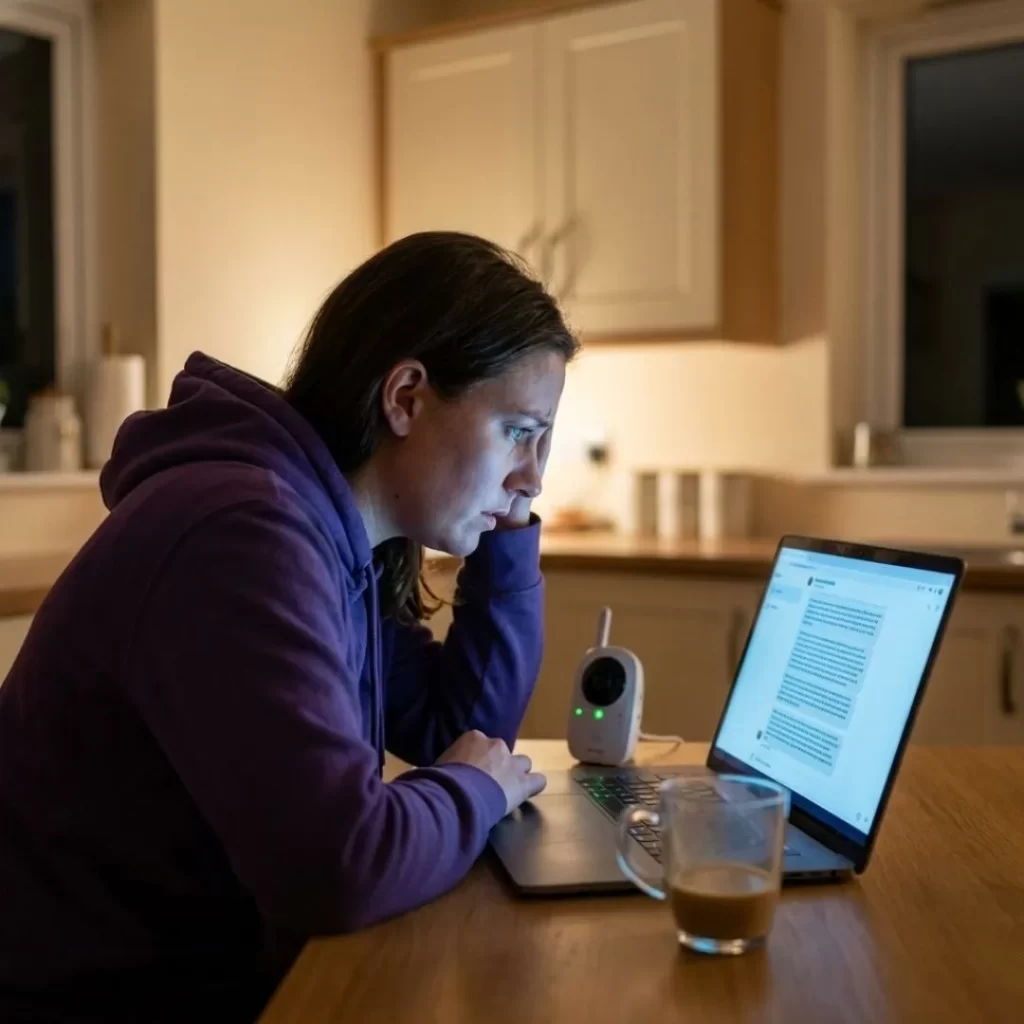
It makes sense. ChatGPT is free, available anytime, and gives fast answers. When your baby wakes up at 3 a.m., and you do not know what is wrong, an AI that talks back feels like a lifeline.
More and more parents are using it. A University of Kansas study found that parents rated AI-generated health text as credible and trustworthy, even when no expert wrote it.1
Pediatricians are seeing this shift too. Parents are arriving at appointments with advice they found on ChatGPT. Some of that advice is fine. Some of it is not.
The problem is not that parents are using AI. The problem is that general AI was never designed for the stakes that come with raising a child.
Still Googling at 2 am?
Text Avo tonight and get:
• Evidence-based answers. No more spiraling through Google.
• Personalized to your child. Avo remembers your family.
• Help knowing when to wait, when to worry, and when to see a doctor.
• Instant answers by text. No app needed.
What Is the Real Difference Between Avocado Health and ChatGPT?
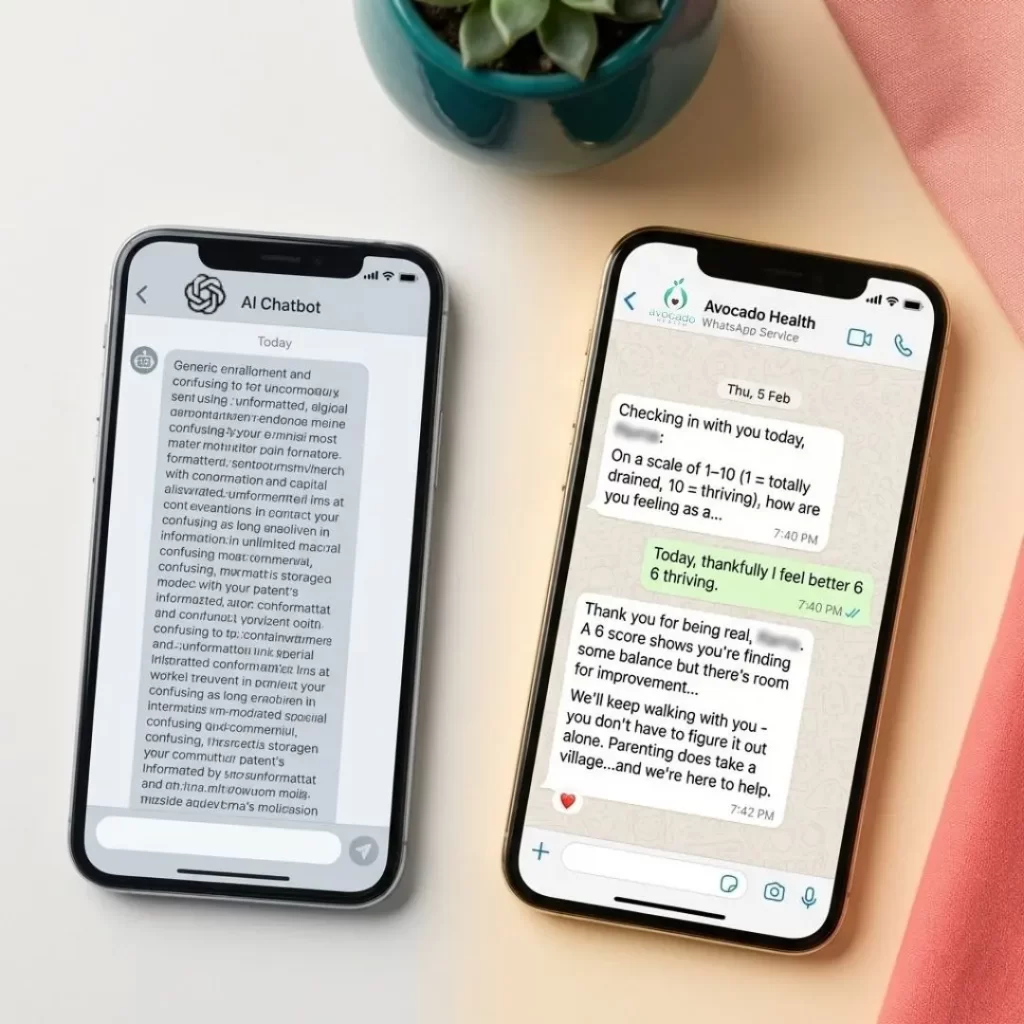
Here is the honest side-by-side. These are not small differences. They are ones that matter for your child’s health and your peace of mind.
Avocado Health vs. ChatGPT / Google
What every parent needs to know before asking AI about their child’s health
|
What matters to you |
✅ Avocado Health |
❌ ChatGPT / Google |
|---|---|---|
|
Proactive guidance |
✓ Sends you milestone reminders, developmental updates, and well-child visit alerts before you even ask. |
✕ Never reaches out. Waits for you to start every conversation. |
|
Human support |
✓ Child life specialists available for 1:1 calls when you need a real person. Speak directly with parenting experts, not just AI. |
✕ No human in the loop. No expert to directly speak with. AI only. |
|
Remembers your child |
✓ Yes. Avo knows your child’s name, age, and past questions. |
✕ No. Every chat starts from zero. |
|
Checks in on you |
✓ Yes. Avo reaches out based on your child’s age and stage. |
✕ No. It only talks when you start the chat. |
|
Parenting focus |
✓ Built only for parents. Nothing else. |
✕ Built for everyone. Not designed for parents. |
|
Where answers come from |
✓ Clinically reviewed sources approved by pediatric experts. |
✕ Trained on the internet. No expert review. Mom blogs, Reddit forums, YouTube videos. |
|
Risk of wrong information |
✓ Sources are checked and updated by our expert team. |
✕ Real risk. Studies show hallucination rates of 50–83% on medical questions. |
|
How you use it |
✓ Text message. No app. No login. No Wi-Fi needed. |
✕ Needs internet, an account, and a device with data. |
|
Care navigation to local resources |
✓ Easy guidance to local area resources specifically supporting parents and families. |
✕ No location-dependent care navigation. |
|
Grows with your child |
✓ Yes. Avo learns more about your family over time. |
✕ No. It gives the same generic starting point every time. |
|
Speaks your language |
✓ Yes. Avo works in multiple languages. |
✕ Varies. Not built around multilingual parenting needs. |
Related articles: Avocado Health vs Traditional Parenting
What Happens When Parents Rely on ChatGPT for Child Health Decisions?
Three independent studies published between 2025 and 2026 now give us a clear answer. The results are consistent and concerning.
ChatGPT Gets Common Pediatric Questions Wrong. And Parents Cannot Tell.
A March 2026 study published in Digital Health tested ChatGPT on 41 real pediatric clinical questions covering three of the most common parenting health topics: vitamin D, food allergies, and sleep problems. Nine pediatric experts reviewed every single response.
- Experts found inaccuracies in more than 1 in 4 of ChatGPT’s answers
- Despite this, the majority of parents rated those same answers as clear, helpful, and trustworthy
- Parents could not distinguish a correct answer from an inaccurate one
The researchers concluded that ChatGPT is not sufficient for safe, standalone clinical decision-making in pediatrics.2
In a Pediatric Emergency, ChatGPT Meets Safety Standards Less Than 6% of the Time
A study published in Cureus in August 2025 tested ChatGPT-4o against the American Heart Association’s official pediatric emergency guidelines. Researchers focused specifically on the situations parents fear most. A child choking. A cardiac event. A breathing emergency. 3
- Only 9.61% of ChatGPT responses were fully and correctly addressed
- Only 5.77% fully conformed to official pediatric safety guidelines
- The majority of responses were partial, lacked depth, or were superficially correct
- Researchers directly warned that incomplete chatbot guidance in a real pediatric emergency could lead to critical errors
Parents Know AI Can Be Wrong. And Use It Anyway.
A cross-sectional survey of 200 families conducted between February and April 2025 and published in Frontiers in Public Health revealed something that explains everything. 4
- 71.2% of parents using AI for pediatric health said the information was only partially accurate
- 52% named inaccuracy and risk of misdiagnosis as the main disadvantages of AI
- 91.1% said they believe AI cannot replace doctors
- Yet the majority still used it regularly because it was fast, convenient, and available at any hour
Parents are not unaware of the risks. They understand AI can be wrong. They use it anyway because nothing better is available at 3am.
What the Research Is Telling Us
Three studies. Three countries. Three different types of pediatric questions. One consistent finding.
ChatGPT gives parents fast answers. It does not give them safe ones.
That is the exact gap Avocado Health was built to fill.
ChatGPT Still Gets Medical Questions Wrong. Even With GPT-5.
Hallucination is when an AI makes up information and states it as fact. It is a known problem with all AI tools. And despite newer versions like GPT-5, the problem has not gone away.
What the Latest Research Shows About GPT-5 and Medical Hallucinations
You might think that newer AI models have solved this problem. They have not.
A study published in Malaysian Family Physician in November 2025 assessed GPT-5 directly. Even with web access, GPT-5 still hallucinated at a rate of 9.6%. That is a 26% improvement over GPT-4o. But it still means roughly 1 in every 10 answers contains fabricated information. 5
And on medical questions specifically, the numbers are worse. According to the 2026 AI Hallucination Research Report, medical queries are one of the highest-risk categories for all AI models. Medical hallucination rates reach up to 15.6% across commonly used models.
Even among the best-performing models, the average rate on medical questions sits at 4.3%. That means even the most accurate AI available still gives a fabricated medical answer roughly 1 in 23 times. 6
ChatGPT Does Not Just Repeat Wrong Information. It Builds on It.
A comprehensive study published in November 2025 evaluated 11 AI foundation models across medical reasoning tasks and surveyed 70 clinicians across 15 specialties. The finding that stood out most was this. Between 64 and 72% of medical hallucinations came from reasoning failures. 7
ChatGPT did not simply lack knowledge. It reasoned incorrectly and then stated that reasoning as confident fact. And 84.7% of clinicians surveyed said those hallucinations were capable of causing real patient harm.
ChatGPT does not say “I am not sure.” It gives you a detailed, confident explanation for something that is not true.
GPT-5 Is Not Meaningfully Safer Than GPT-4 on Health Questions
This is the finding that matters most for parents choosing which AI to trust.
A study published in JAMA Psychiatry in March 2026 tested GPT-4o, GPT-5 Auto, and the free version of ChatGPT on health-related questions. The researchers found no statistically meaningful difference in accuracy or safety between GPT-5 and GPT-4o. 8
The lead researcher stated directly that although OpenAI has made claims about improved safety with GPT-5, no statistically meaningful difference was found between the GPT-5 and GPT-4o versions in their tests.
ChatGPT Sounds Most Confident Exactly When It Is Most Wrong
This has not changed across any version of ChatGPT.
MIT research published in 2025 found that AI models are 34% more likely to use phrases like “definitely,” “certainly,” and “without doubt” when generating incorrect information than when providing accurate answers. The answer that sounds the most sure of itself is the most likely to be wrong. 9
When you are a tired parent at 1am trying to decide if your baby needs urgent care, a confident wrong answer is dangerous. Whether it comes from GPT-4 or GPT-5.
Does Avocado Health Remember My Child?

Yes. And this is one of the biggest differences.
When you text Avo about your 8-month-old’s sleep, Avo saves that. The next time you reach out, Avo already knows your child’s age, what you were worried about before, and what you have already tried.
ChatGPT does not work this way. Every single conversation starts from nothing. You explain your child’s age and history every time. It has no way to know that last week you asked about feeding, or that your toddler has been having tantrums for three months.
Every child develops differently. A response that fits a 6-month-old is wrong for a 9-month-old. Avo knows the difference for your child specifically. ChatGPT cannot.
Related articles: Need the Best Parent Coaching? Text Avocado Health
What Does the Research Say About Specialized vs. General AI for Parents?
Scientists have now studied this question directly. The answer is clear.
A 2025 study published in JMIR Pediatrics and Parenting looked at what parents actually wanted from AI tools for their children’s health.
The study’s conclusion:
Parents strongly prefer a specialized, trusted chatbot designed with input from health professionals.
General AI tools do not meet what families need when managing their child’s health. 10
Parents wanted to understand why the AI gave a specific recommendation. They did not want to just accept an answer from a black box.
They wanted an AI that was transparent, built by health experts, and designed around their child’s real needs.
That is exactly what Avocado Health is built to be.
Is ChatGPT Safe to Use for Baby and Child Health Questions?
The short answer is: it depends on the question, and the risk is real.
ChatGPT is trained on a massive amount of internet content. That includes outdated advice, forum posts, personal opinions, and information that no medical professional has ever reviewed.
- The model can sound very confident even when it is completely wrong.
- In spite of technological advancements, the 10 leading AI tools, including ChatGPT, Claude, Gemini, and Perplexity, were more likely to spread misinformation on news-related topics.
- The rate of false claims made by top AI chatbots nearly doubled in one year, rising from 18% to 35% between August 2024 and August 2025. 11
- For low-stakes questions, a wrong answer is frustrating. For a parent asking whether their baby’s breathing is normal, or whether a rash needs urgent care, a wrong answer can have real consequences.
Avocado Health is different. Its knowledge base is built from clinically validated research. Every source is reviewed by our team of pediatric experts. When you ask Avo a question, the answer comes from the same evidence base your pediatrician uses.
Does Avocado Health Check In With Me, or Do I Have to Ask Every Time?
Avo checks in with you. ChatGPT waits.
Your baby’s needs at 4 months are completely different from their needs at 6 months. Your toddler’s milestones shift week by week. The questions you have this month are not the same ones you will have next month.
Avocado Health follows that curve with you. Avo sends you guidance based on your child’s age and stage before you even know you need it. After a conversation, Avo follows up to check that things are going well. Avo will proactively guide you across your unique parenting journey, letting you know what milestones are coming up and how you can strengthen your child’s development with at-home activities.
Avocado Health does not just answer questions. It anticipates them. Before your baby reaches a new developmental stage, Avo lets you know what is coming. Before a well-child visit, Avo sends you a reminder to be prepared.
And when a conversation needs more than AI can offer, Avo connects you with a real child life specialist for a 1:1 call. ChatGPT has no human in the loop at all. It cannot escalate. It cannot connect you to anyone. It simply answers and waits.
ChatGPT will answer any question you type. But it never reaches out. It never follows up. And it never knows anything about your child unless you tell it again.
Can I Use Avocado Health Without Wi-Fi or a Smartphone App?
Yes. This was built into Avo by design.
Avo works through simple text messaging. No app to download. No account to set up. No internet connection beyond basic cell service. You text Avo the same way you text a friend.
Parenting emergencies do not always happen at home with good Wi-Fi. They happen in the car, at the playground, in a waiting room, or in the middle of the night. Even telehealth doesn’t solve the real, immediate gaps in knowledge and awareness of resources.
ChatGPT needs a strong internet connection, an account, and usually the app. That friction is a real problem at exactly the moments when you need help the most.
Avo is also multilingual. Whatever language your family speaks, Avo speaks it too.
How Does Avocado Health Build Trust Over Time?
Trust is built through consistency. It grows when you get accurate, helpful answers again and again.
Every time you text Avo and get an answer that is right for your specific child, that trust gets stronger. Avo is not trying to impress you with how much it knows. It is trying to help you make the right call for your family.
Over time, Avo becomes more useful because it knows more about your child. It remembers what worked. It remembers what worried you. The longer you use it, the better it gets.
General AI tools are built for breadth. They try to answer as many different questions for as many different people as possible. That is the opposite of what you need as a parent.
Pediatricians want parents to have access to good information. They want it to be safe, accurate, and right for each specific child. That is exactly what Avo delivers.
Conclusion
Avocado Health and ChatGPT: Both tools can answer parenting questions, but only one is built actually to support your family.
ChatGPT is a powerful general AI with many uses, but child health is not one of them. Research now shows the gaps that come from that.
Avocado Health is purpose-built for parents. It knows your child, uses expert-reviewed evidence, and checks in proactively. It works on any phone, without an app, without Wi-Fi, and in your language.

Sources:
- Study finds parents relying on ChatGPT for health guidance about children, University of Kansas
- Safety and user perception of LLMs in pediatric healthcare. Tan et al., Digital Health, March 2026
- AI Chatbots in Pediatric Emergencies: A Reliable Lifeline or a Risk? Kular et al., Cureus, August 2025
- Parents’ understanding and attitudes toward AI in pediatric healthcare, Huang et al., Frontiers in Public Health, August 2025
- Marked reduction in hallucination rates with GPT-5, Malaysian Family Physician, November 2025
- AI Hallucination Statistics Research Report 2026, Suprmind
- Medical Hallucination in Foundation Models and Their Impact on Healthcare, Kim et al., medRxiv, November 2025
- ChatGPT exhibits high rates of inappropriate responses on health questions, JAMA Psychiatry, March 2026
- AI Hallucinations in 2026: Why AI Still Gets Things Wrong, citing MIT research, 2025
- Exploring the Acceptance and Opportunities of Using a Specific Generative AI Chatbot to Assist Parents.
- NewsGuard Report, 2025
0 comments