


When do babies start sweating? It varies by age and development. Babies can sweat shortly after birth, but patterns change as their nervous system and temperature regulation mature throughout the first year. Learn what to expect as your baby grows.
When do babies develop sweat glands?
Infants are born with a full set of sweat glands, but their body’s ability to use them for thermoregulation develops gradually over the first year of life. Newborn sweating is common, and a sweaty baby often means they’re too hot, usually from being overdressed or in a warm environment.
When Do Babies Start Sweating?

Babies typically begin to sweat shortly after birth, although the patterns and intensity of sweating evolve as their bodies mature. Eccrine sweat glands form during pregnancy, covering most of the body by the fifth month.1
Baby Sweating Timeline by Age:
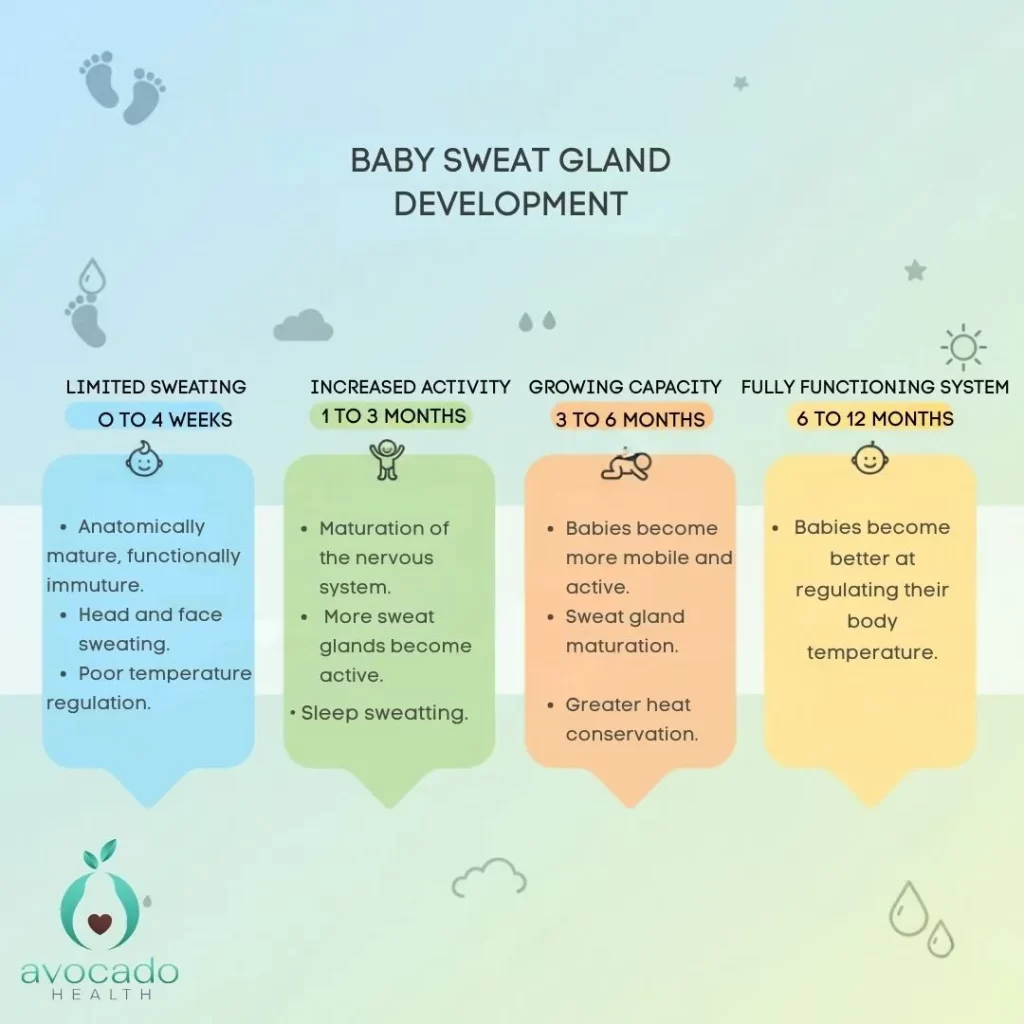
0 to 4 weeks: Limited sweating
- Anatomically mature, functionally immature: At birth, a full-term baby’s eccrine sweat glands are morphologically mature, but only a small fraction are functionally active. Babies start developing sweat glands in the womb and can sweat from day one, especially on the forehead, but this sweating is inefficient.2
- Head and face sweating: Initial sweating activity is often limited to the head and face, where the sweat glands are more concentrated and become active earlier.
Head sweating is common in newborns, especially during feeding, sleep, or when overdressed, and is usually not a sign of concern unless accompanied by other symptoms such as fever or breathing issues.
If sweating seems persistent or excessive, especially outside of warm environments, it may be helpful to learn more about excessive sweating in newborns.
- Poor temperature regulation: Newborns cannot regulate their body temperature effectively, relying instead on caregivers and their environment to stay warm or cool. However, they are at greater risk of getting too cold than too hot.
- Reliance on other mechanisms: Since they can’t sweat efficiently, newborns use other methods to cool down, such as breathing faster or increasing blood flow to the skin’s surface. When cold, newborns rely on other mechanisms like non-shivering thermogenesis to regulate temperature.3
Because breathing plays a role in temperature regulation, parents may notice rapid breathing while a newborn is sleeping, which is often normal but can be confusing to observe.4
1 to 3 months: Increased activity
- Maturation of the nervous system: As the nervous system matures, it gains better control over the sweat glands.
- Recruitment of glands: More sweat glands become active during this period, and sweating becomes more noticeable. Common triggers for sweating in infants include deep sleep, feeding, overdressing, and crying.
- Sleep sweating: Because infants spend more time in deep sleep cycles compared to adults, it’s common for them to sweat on their head and face during sleep. Many parents also notice head sweating during contact naps, especially when a baby sleeps chest-to-chest, as shared body heat can easily build up.
3 to 6 months: Growing capacity
- Increased activity and mobility: As babies become more mobile and active, increased sweating is a normal physiological response, and their sweating capacity and regulation further improve.
Sweating during feeding is common, as it increases the baby’s metabolic rate and generates heat, but excessive sweating may indicate a health issue.
- Improved maturation: By around four months, indicators of sweat gland maturation in full-term infants stabilize, reflecting a significant increase in functionality.
- Greater heat conservation: By three months, a thicker layer of subcutaneous fat and a more effective peripheral vasomotor response help the infant better conserve heat.5
6 to 12 months: Fully functioning sweat gland system
- Established thermoregulation: Between 6 and 12 months, a baby’s thermoregulation system becomes much more functional and starts to work similarly to an adult’s, which is a sign of normal development.
- Adapted to external conditions: By 9 to 12 months, a baby should be able to adjust their body temperature to external conditions more effectively, reflecting normal development.
- Body odor: During infancy, only eccrine glands are active, which do not produce body odor. Apocrine glands, the type associated with body odor, activate at puberty. This is a normal part of development, so a baby’s sweat is typically odorless.6
Still unsure if your baby’s sweating is normal? Text Avocado Health for 24/7 parent coaching and expert-backed answers tailored to your baby whenever you need them.
Conclusion
Babies start sweating shortly after birth, but noticeable sweating usually becomes more apparent between 1 and 3 months of age as the nervous system matures. Early sweating is most common on the head and face, and patterns continue to develop throughout the first year of life.
Frequently Asked Questions
Sources:
- Functional skin adaptation in infancy – almost complete but not fully competence
- Eccrine sweat gland development and sweat secretion
- The Role of Brown Adipose Tissue and Energy Metabolism in Mammalian Thermoregulation during the Perinatal Period
- Hyperthermia and Heat Stress as Risk Factors for Sudden Infant Death Syndrome
- Pediatric Thermoregulation
- Body odor samples from infants and post-pubertal children differ in their volatile profiles