
When do babies start holding their head up? If your baby can only manage a few wobbly seconds right now, that’s totally normal. Most babies start showing signs as early as 1 month and get stronger and more consistent between 3-6 months. This is the foundation for sitting, crawling and exploring. Learn the head control timeline and how to support your baby’s progress.
Table of Contents
What is a milestone for holding head up?

Holding head up is a big milestone for your baby. During this time, you need to support your baby’s neck as they work on developing neck control and gradually gain enough control to hold their head up.
Why is it important for babies to reach the milestone of holding their heads up?

Holding up their head is important because it builds the strength and control for all future gross motor skills such as:1
- Foundation for motor skills: The neck and back muscles developed through holding up their head is the foundation for all other movements. This includes rolling over, pushing up to look around, sitting up, and eventually crawling and walking.
- Supports development of other muscles: Lifting their head strengthens the upper body muscles and helps the baby to be more steady and upright when sitting.
- Allows for exploration and learning: When your baby can hold their head up they can turn to look at faces, listen to your voice and see what’s happening around them. This active engagement is key to their learning and sensory development.
- Required for swallowing solids: Proper head and neck control is a pre-requisite for your baby to be able to swallow solids later on.2
When do babies start holding their head up? Developmental timeline

Babies start to hold their head up around 3 months old, though they may show signs of lifting it briefly as early as 1 month. Full head control develops gradually over the first six months of a baby’s life, marking an important milestone in their overall development.3
Developmental timeline
- 1 month: Babies may turn their head from side to side and briefly lift it when on their tummy, beginning to develop the ability to hold their head up.
- 3 months: Babies should be able to hold their head up with more ease, and may begin pushing up on their forearms during tummy time. Most babies develop enough neck strength to hold their heads up by around this age.4
- 4 months: Babies are often able to hold their head up while in a sitting position, showing improved head and neck control.
- 6 months: Babies will have gained much more control over their head and neck muscles, consistently holding their head steady.
Achieving head control is a crucial step in your little one’s life, laying the foundation for later milestones such as crawling and eventually walking.
How to help baby learn to hold head up?
Here are some activities that encourage head lifting:5
- Lay your baby tummy-down across your arms. Rock them back and forth. Do this in front of a mirror, and your baby will lift their head. Even just a minute of tummy time is beneficial, especially in the early days.
- You can also put a rolled-up blanket or cushion under your baby’s chest and arms for extra support so they can lift their head.
- Gradual: As your baby gets better at lifting their head, they will gradually need less support.
- Be prepared: Even when your little one has good head control, they still need to be careful and have a hand ready to support them when you pick them up.
When can you stop supporting a baby’s head?
You can stop providing full head support for a baby’s head between 4 and 6 months when their neck and back muscles are strong enough to hold their head up on their own.
Every baby develops at their own pace, and some may reach head control milestones earlier or later than others.
If your little one hasn’t started showing signs of head control by 4 months, it’s a good idea to consult their healthcare provider to ensure everything is progressing well.
When do babies hold their head up during tummy time?

Tummy time should always be done on a safe, comfortable surface, such as a play mat, activity mat, or other soft surface, to support your baby’s development.
The timeline for head control during tummy time:
- 0-4 weeks: May lift their head briefly and turn it from side to side, especially during chest-to-chest tummy time. Help your baby practice lifting their head while on a soft surface.
- 1 month: Lifts head a bit longer and starts to push up with their arms. Place your baby on their tummy on a play mat or activity mat for short, supervised sessions.
- 2 months: Lifts head and upper chest off the floor at a 45- to 90-degree angle and starts to push up on their forearms. This helps develop upper-body and core strength. Put toys within reach to encourage engagement during tummy time.
- 3 months: Pushes up higher on arms, with chest coming off the ground. They start to turn their head smoothly in both directions and build more consistent head control.
- 4 months: Lifts head and chest using straighter arms, like a “mini push-up”. Tummy time should be done a few times a day in short sessions to support this development and help the baby strengthen their neck, back, and shoulder muscles.
Why won’t my baby lift their head during tummy time?
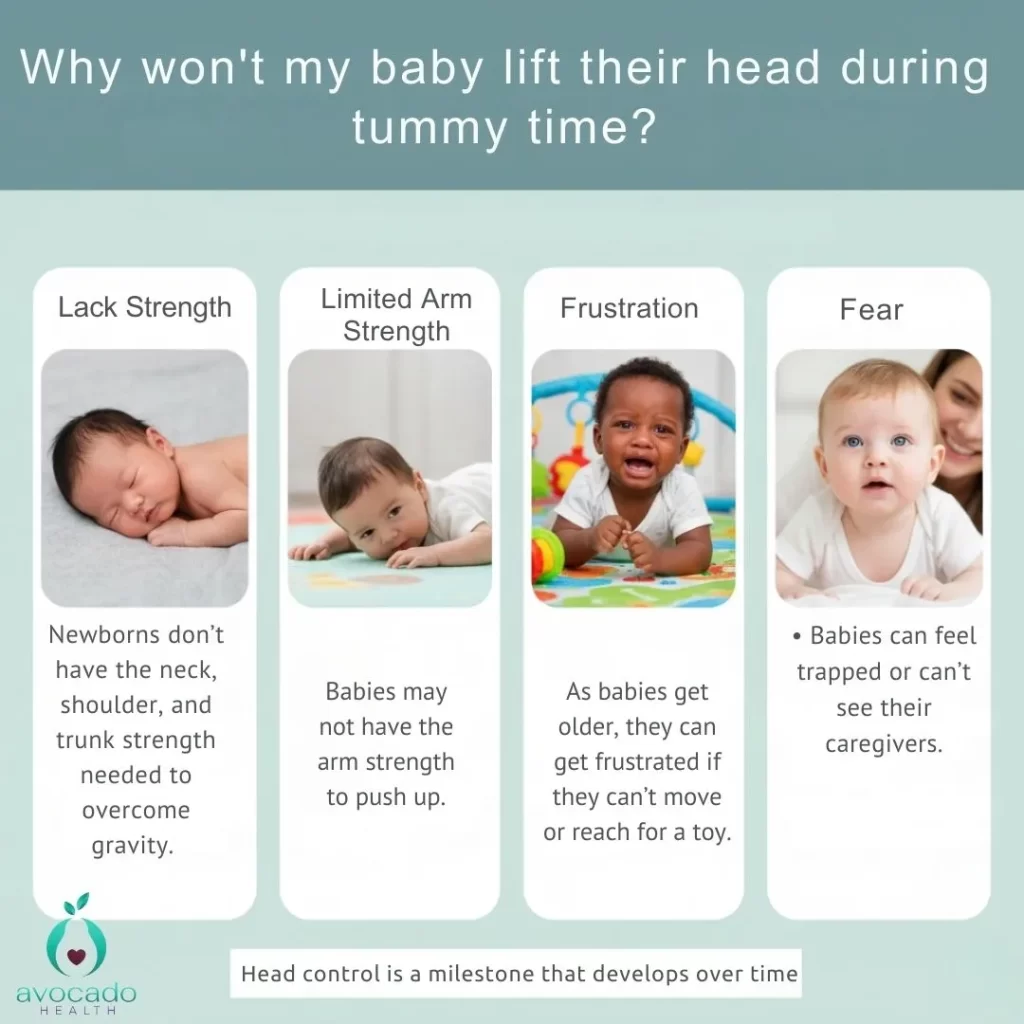
Common reasons a baby won’t lift their head during tummy time include:
- Lack of strength: Newborns don’t have the neck, shoulder, and trunk strength needed to overcome gravity. When on their tummies, babies’ heads are bigger than their bodies, making it harder for them to develop head control.
- Limited arm strength: Pushing up with their arms helps babies lift their head higher. They may not have the arm strength to do this at first.
- Frustration: As babies get older, they can get frustrated if they can’t move or reach for a toy in this position.
- Fear: Babies can feel trapped or can’t see their caregivers when in this position.
- Developmental milestone: Head control is a milestone that develops over time.
When to worry about baby not holding head up?
Talk to your pediatrician if you have any concerns. Red flags include:
- Your baby is 3 months and can’t lift their head at all.
- Your baby has poor head control or head lag after 4 months.
- Your baby only turns their head to one side, which could be a sign of torticollis.
- You notice overall floppiness or rigidity in their body.
- Your baby loses skills they had.
- Early intervention can help with any underlying issues.
Ready to feel confident about your baby’s growth and milestones?
Text Avocado Health for caring, expert parent coaching available 24/7 designed just for you and your little one.
Frequently Asked Questions
Is it normal for a 2 month old to lift their head?
Yes, it is normal, but they won’t have full control yet. During tummy time, babies begin lifting their head, a process known as head lifting, which helps build neck and trunk strength.
At birth, newborns cannot control their heads because their motor skills aren’t developed and their neck muscles are weak.
At what age can a newborn hold their head up while being held upright?
As the baby grows and gains more upper body strength they gradually improve their ability to hold their own head steady. By 3 months, most babies have enough neck muscle development to hold their head up with some support, and by 4 to 6 months, many can hold their head upright steadily without assistance.
What happens if you don’t support a baby’s neck?
If an infant’s head is not adequately supported, the main risk is that their airway could become blocked, preventing them from crying out to signal a problem.
Sources:
- Infant Head Lag https://www.ncbi.nlm.nih.gov/books/NBK567782/#:~:text=Introduction,first%20few%20weeks%20of%20life.
- Early Development of Head Movements Between Birth and 4 Months of Age: A Longitudinal Study https://www.researchgate.net/publication/265516809_Early_Development_of_Head_Movements_Between_Birth_and_4_Months_of_Age_A_Longitudinal_Study#:~:text=Movement%20units%20initially%20increased%20in,after%203%20months%20of%20age.
- Motor Skills: Development in Infancy and Early Childhood https://www.researchgate.net/publication/304191163_Motor_Skills_Development_in_Infancy_and_Early_Childhood
- Relationship between the prone position and achieving head control at 3 months. https://www.researchgate.net/publication/236042155_Relationship_between_the_prone_position_and_achieving_head_control_at_3_months#:~:text=Conclusions%3A%20The%20significant%20findings%20suggest,head%20control%20at%20three%20months.
- Early Intensive Postural and Movement Training Advances Head Control in Very Young Infants https://academic.oup.com/ptj/article-abstract/92/7/935/2735285?redirectedFrom=fulltext&login=false