
When do babies start holding their own bottle is a milestone of independence and coordination. Some will surprise you early and rip the bottle out of your hand, others will relax and let you help a little longer. Both are normal! This isn’t just about feeding; it’s a sneak peek into your baby’s developing motor skills and confidence. Learn how to spot the signs of readiness and help your little one master this new skill with ease.
Table of Contents
Is Holding A Bottle A Milestone?
Yes, a baby holding their own bottle independently, known as the bottle-holding milestone, is considered a developmental milestone that indicates progress in their motor skills, coordination, and burgeoning independence.
Keep in mind that some babies might skip holding a bottle entirely and go straight to using a cup, and that’s perfectly normal.
At What Age Can Babies Feed Themselves?
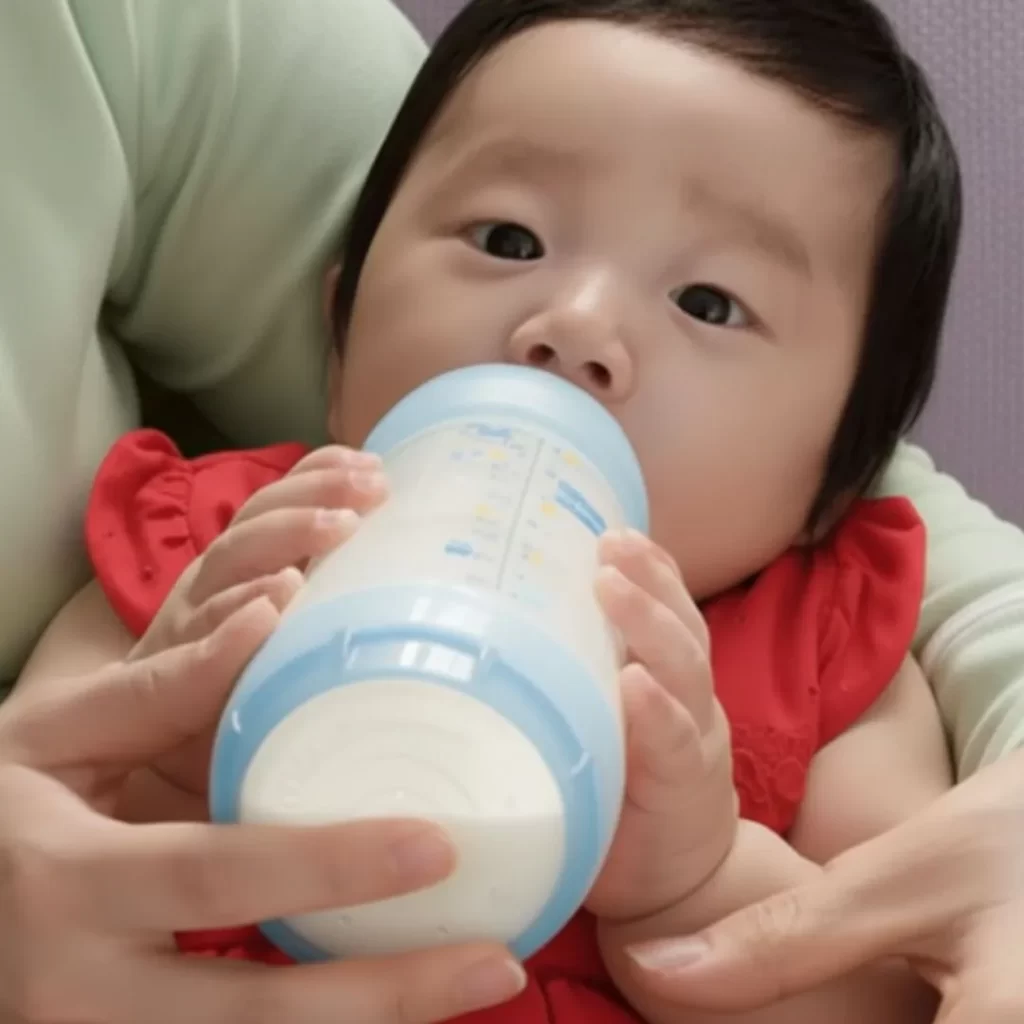
Babies begin learning to self-feed when solid foods are introduced around 6 months of age, starting with finger foods and progressing to using utensils and their own cup over the next few years. 1
Self-Feeding Development Timeline
This process happens in stages as their fine motor skills and coordination improve. The following timeline outlines typical ages for each milestone: 2

As children grow, they eventually master these self-feeding skills, becoming proficient and independent at mealtimes.
When Do Babies Start Holding Their Own Bottle and feeding themselves?
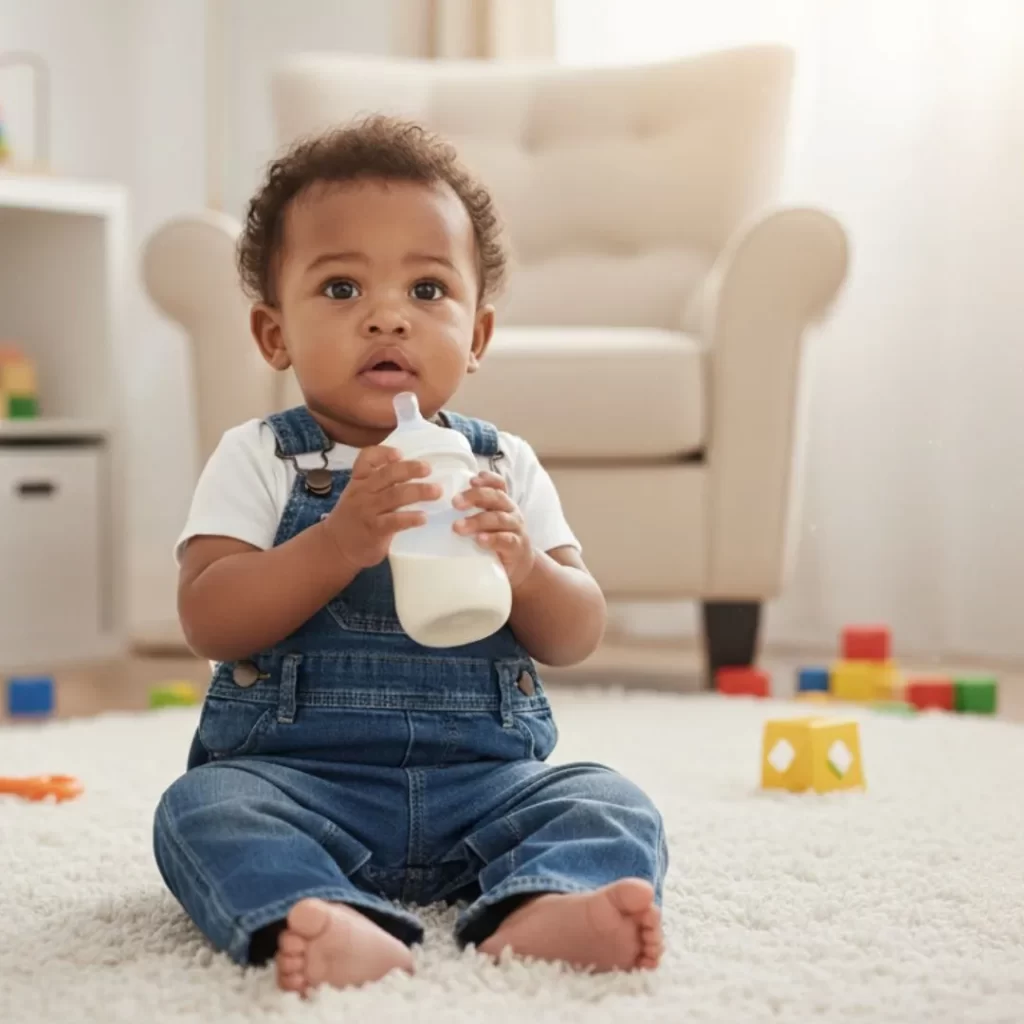
Babies typically start holding their own bottles between 6 and 10 months of age.
The exact timing varies widely from one child to the next, as it depends on individual development of key physical skills.
However, most will experience the baby hold milestone and baby learn to grasp and manage a bottle or cup as a baby grows. 2
What Are The Signs A Baby Is Ready To Hold A Bottle?
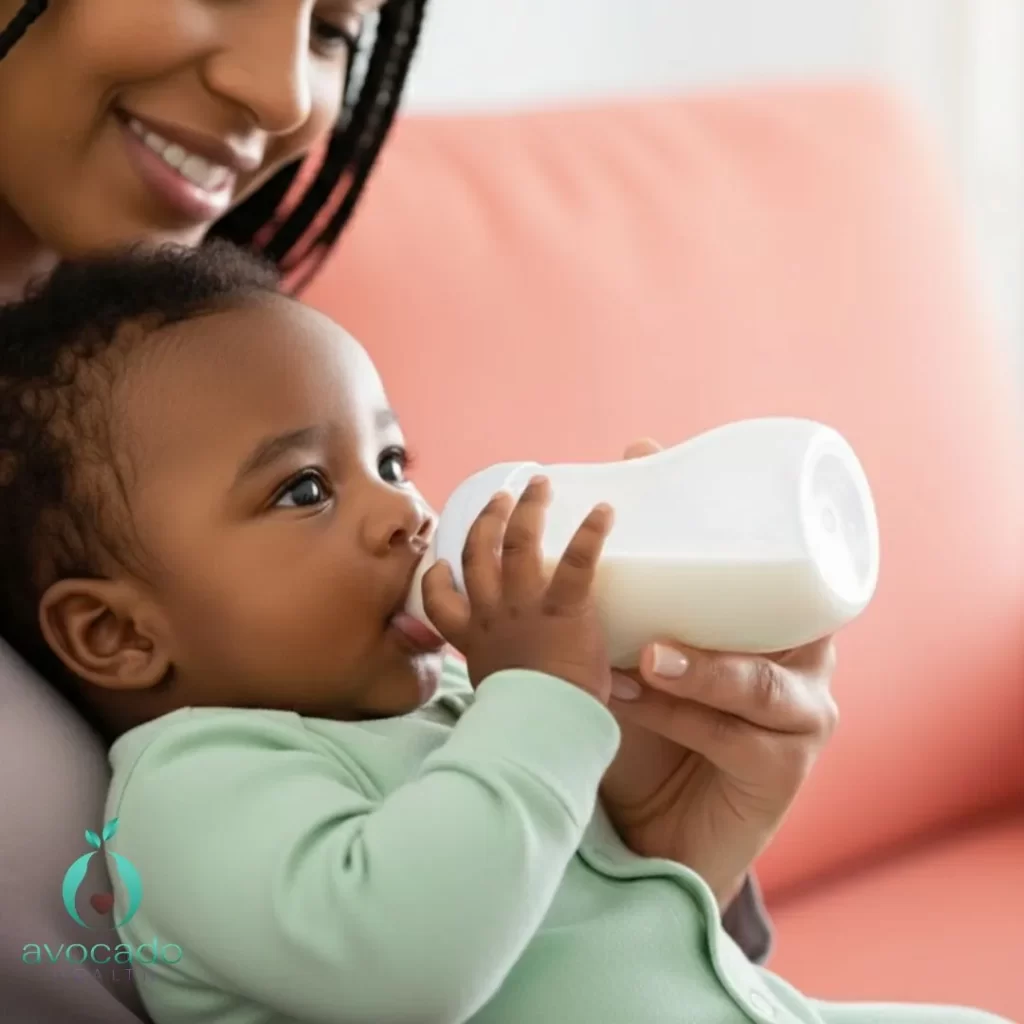
Readiness signs are primarily related to the development of motor skills, cognitive development, and a demonstrated interest in self-feeding. Here are some common signs to look out for:
Ability To Sit Up Independently
Strong core and upper body strength are essential for stability while feeding. A baby should be able to sit upright with minimal or no support, as sitting up independently is a milestone that enables them to start holding a bottle or cup on their own.
Reaching For And Grasping Objects
By 8 to 9 months, most babies develop the strength and coordination to hold objects like bottles and cups, an exciting sign of growing independence.
When your baby starts reaching for the bottle or grabbing nearby toys, it shows that their fine motor skills and hand-eye coordination are improving. 3
Bring Their Hands And Objects To Their Mouth
Another sign is when your baby brings their hands and objects to their mouth. This is part of their natural development and shows they are learning to coordinate movements.
When you see your baby trying to put the bottle in their mouth, it can be a cue that they are ready to try holding it during feeding.
As babies practice holding different items, they develop the fine motor skills needed for feeding.
Putting Their Hands On The Bottle During Feeding
This is a direct cue that the baby is interested in taking control of the bottle.
Interest In Self-Feeding With Solids
When a baby shows an interest in picking up finger foods and bringing them to their mouth, it’s a good indicator of overall self-feeding readiness.
Once a baby can hold their own bottle, they may also begin to show interest in self-feeding and other milestones. 4
Good Head And Neck Control
Proper head control is necessary to maintain a safe feeding position and prevent choking.
Babies are born with relatively large heads and weak neck muscles, which is why their heads often lag or flop back when you pull them to sit up during the first few weeks.
It’s completely normal for parents to support their baby’s head until around 3 to 4 months old, when most infants gain enough neck strength to hold their head steady in line with their shoulders.
This skill, called head control, is an important step in their overall motor development.5
Important Considerations
Individual Pace:
Development varies widely; most babies show these signs between 6 and 10 months, but some may be earlier or later.
Transitioning to Cups:
- At this age, you may also want to introduce a sippy or open cup, as the American Academy of Pediatrics recommends weaning off the bottle between 12 and 18 months.
- Prolonged bottle use is associated with increased children’s BMI-for-age percentile. 6
- During this transition, you may notice your baby is ready to try breast milk or formula from a cup, especially if your child is a breastfed baby.
- If your baby uses the bottle as a comfort object, consider replacing it with a soft toy or blanket to ease the transition.
This is also the time to introduce solid food, which is another exciting feeding milestone.
How To Teach Your Baby To Hold Their Own Bottle?
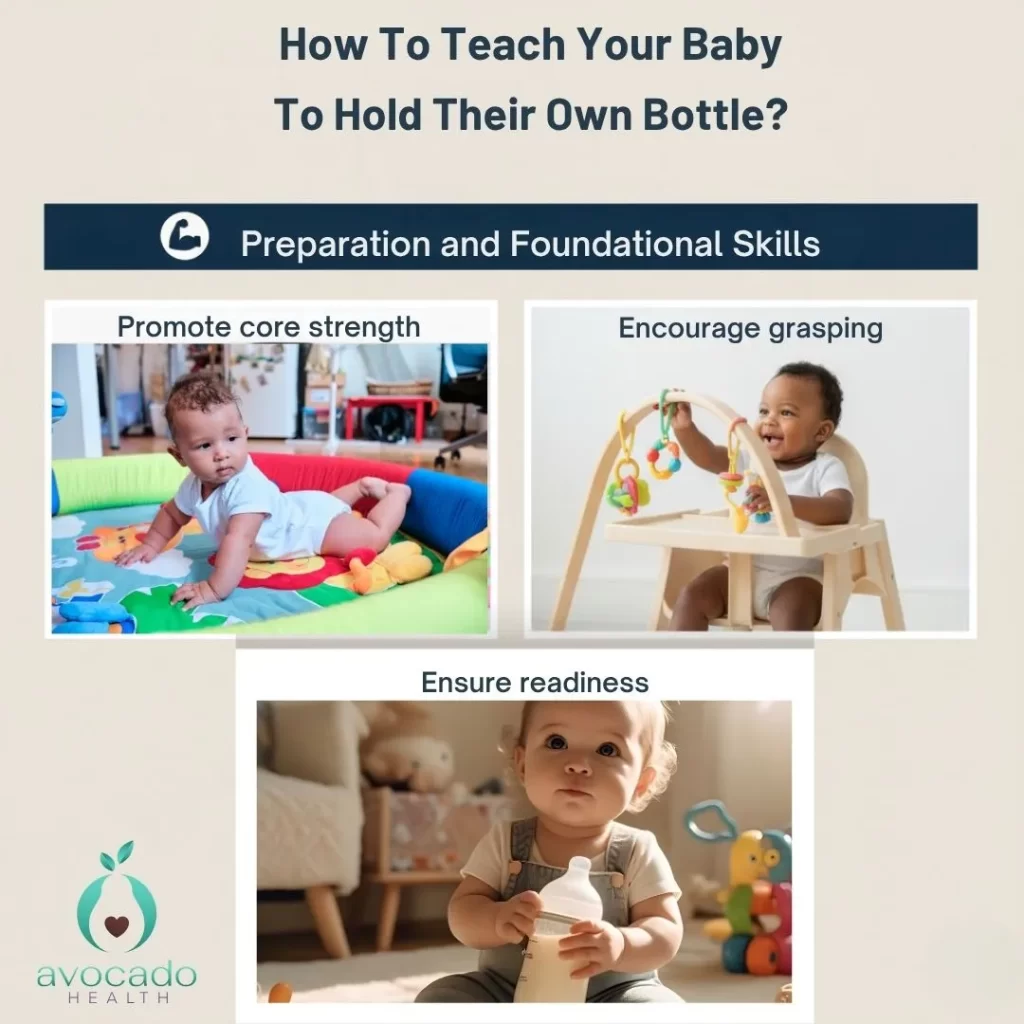
To teach your baby to hold their own bottle, focus on encouragement and practice rather than forcing the skill. This process involves building their core strength and coordination and using specific techniques during baby feeds and bottle feeds.
Preparation and Foundational Skills
Before actively teaching the skill, ensure your baby has the foundational motor skills:
- Promote core strength: Engage in regular tummy time and activities that encourage reaching for toys while sitting, as strong core and upper body muscles are necessary for stability while feeding themselves.
- Encourage grasping: Offer a variety of easy-to-hold toys, like rattles or teething rings, and encourage your baby to pick them up and bring them to their mouth. This builds hand-eye coordination.
- Ensure readiness: Only attempt to teach the skill when your baby can sit up with little or no support and shows an interest in grabbing the bottle during feeds.
Techniques for Teaching
Use these methods to gently encourage your baby toward holding the bottle independently:
- Start with a partially full bottle: A full bottle can be too heavy for a baby to hold on their own. Begin with only a couple of ounces and gradually increase the amount as their strength improves.
- Guide their hands: During bottle feeds, gently place your baby’s hands around the bottle. You can place your hands over theirs to guide the bottle to their mouth, helping them feel the correct position and movement.
- Practice with an empty bottle: Let your baby play with an empty bottle during playtime to get used to the feel and shape without the pressure of feeding.
- Use appropriate equipment: Consider using lightweight bottles or ones with easy-to-grasp handles to make it physically easier for your baby.
- Model the action: Demonstrate the hand-to-mouth motion using a bottle or a toy to show them what to do.
- Be patient and positive: This is a new, complex skill that takes time to master. Offer praise and encouragement for their efforts during each baby feed.
Important Safety Precautions
- Supervise all feeds: Never leave your baby unattended with a bottle, even if they can hold it themselves. A baby could choke, and feeding time is an important bonding opportunity.
- Avoid bottle propping and bottle propper devices: Never use pillows, bottle proppers, or other objects to prop a bottle in your baby’s mouth. This is dangerous and increases the risk of choking, ear infections, and tooth decay.
Milk can also pool around a baby’s teeth if they fall asleep with a bottle, leading to tooth decay.
- Maintain an upright position in a high chair: Ensure your baby is sitting up or at a slight incline, ideally in a high chair, while feeding to help them swallow effectively and reduce the risk of ear infections.
Why Isn’t My Baby Holding Their Bottle?
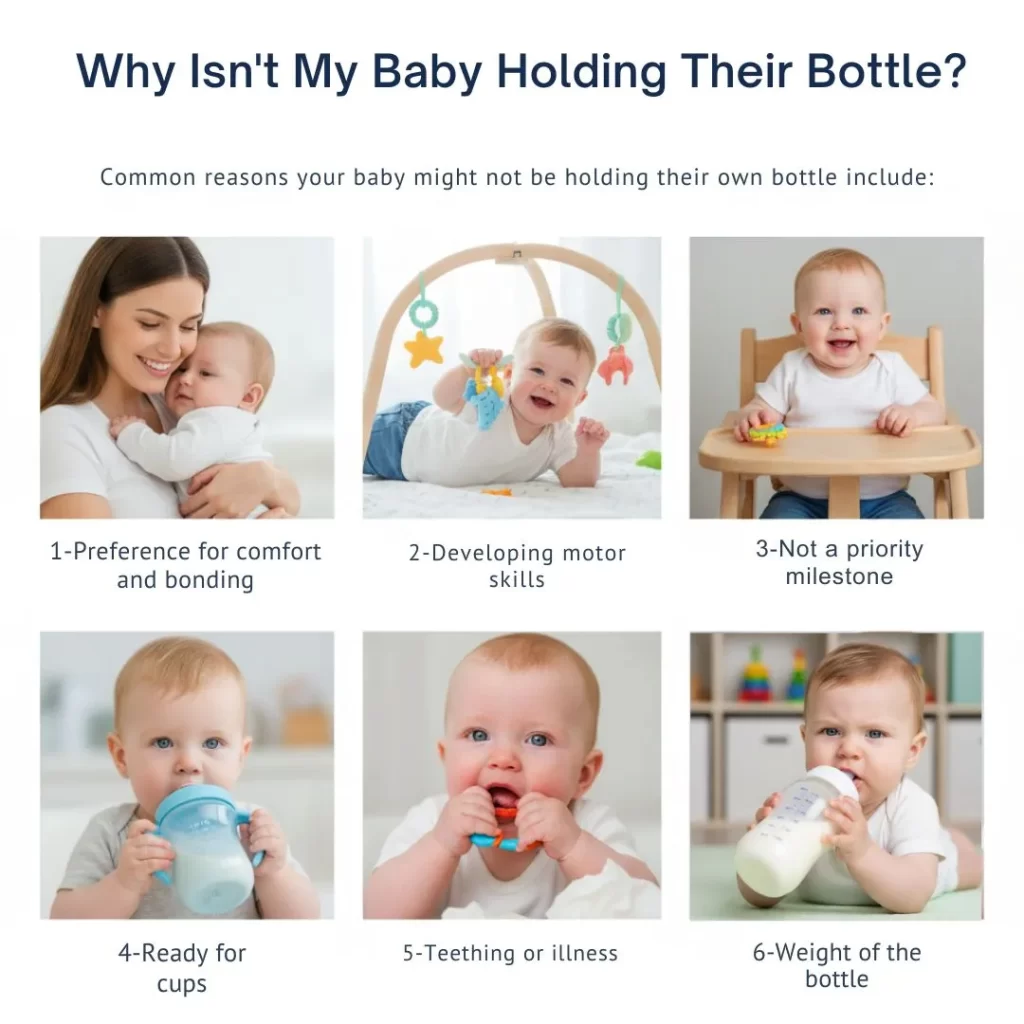
Common reasons your baby might not be holding their own bottle include:
- Preference for comfort and bonding: Feeding time is a major bonding opportunity. Many babies prefer the physical closeness, comfort, and security of being held and fed by a caregiver. They are seeking affection as much as nourishment, and some other babies simply enjoy being fed rather than holding the bottle themselves.
- Developing motor skills: Holding a bottle requires fine motor skills, hand-eye coordination, and upper body strength. Your baby may still be developing the muscle control needed to hold the bottle steadily and direct it to their mouths for an entire feeding.
- Not a priority milestone: Some babies prioritize other developmental milestones, and feeding skills happen at their own pace. A lack of interest in holding the bottle is generally not a concern on its own.
- Ready for cups: At around 9 months of age, your baby might be signaling that they are ready to transition to a sippy or straw cup. They may show less interest in the bottle altogether and more interest in self-feeding with solids.
- Teething or illness: Discomfort from teething or an illness can cause a temporary lack of interest in feeding or holding the bottle.
- Weight of the bottle: A full bottle can be heavy. A baby might be able to hold a lighter, nearly empty bottle, but struggle with a full one.
When To Consult A Pediatrician?
In most cases, this is a normal variation of development. However, you should reach out to your pediatrician if you notice other concerns, such as:
- Lack of interest in holding other toys or objects and bringing them to their mouth.
- Other significant developmental delays in motor skills or growth.
- Signs of dehydration (e.g., fewer wet diapers, no tears when crying).
- A complete refusal to drink milk or formula for several hours.
- Signs of ear infections, which can be more common in bottle-fed infants, may occur due to liquid entering the middle ear through the eustachian tubes.
Wondering When Your Baby Will Be Ready To Hold Their Own Bottle?
Text Avocado Health anytime for personalized parent coaching and expert support day or night.
Conclusion
Every baby develops at their own pace, so don’t stress if your little one isn’t holding their bottle just yet. Celebrate every small step and support them gently. This milestone is just one of many in your baby’s growing independence.
Frequently Asked Questions
Should a 5-month-old be able to hold a bottle?
No, a 5-month-old typically cannot hold their own bottle. While some may show early interest and pick it up, most babies reach this milestone between 6 and 10 months.
Can breastfed babies learn to hold a bottle at the same pace as formula-fed babies?
Yes, breastfed babies can learn to hold a bottle just like formula fed babies, especially if given time and practice. It may take a little while to adjust but that’s totally normal.
Using paced feeding to mimic the flow of breastfeeding can make this transition easier. This way breastfed and formula fed babies can adjust and learn at the same time.
What if my baby only grabs the bottle but doesn’t hold it the whole time? Does that count?
A baby only needs to initiate the action and show some control for it to be considered a step toward holding their own bottle.
Grabbing the bottle and holding it even for a short time demonstrates emerging hand-eye coordination and fine motor skills.
Sources:
- Fingers, Spoons, Forks, and Cups https://www.cdc.gov/infant-toddler-nutrition/mealtime/fingers-spoons-forks-and-cups.html#:~:text=By%20the%20time%20children%20are,feed%20themselves%20with%20their%20fingers.
- Development of eating skills in infants and toddlers from a neuropediatric perspective https://pmc.ncbi.nlm.nih.gov/articles/PMC11149262/#:~:text=The%20development%20of%20sucking%20and,age%20%5B8%E2%80%9311%5D.
- Outcomes and Hand Use of Reaching Attempts: Comparison of Infants at Risk for Developmental Disability and Infants With Typical Development https://www.frontiersin.org/journals/psychology/articles/10.3389/fpsyg.2022.712252/full
- Effects of exercise interventions on hand-eye coordination and fine motor skills in children with developmental coordination disorder: a meta-analysis https://pmc.ncbi.nlm.nih.gov/articles/PMC12575161/
- Infant Head Lag https://www.ncbi.nlm.nih.gov/books/NBK567782/
- Age of Bottle Cessation and BMI-for-Age Percentile among Children Aged Thirty-Six Months Participating in WIC https://pubmed.ncbi.nlm.nih.gov/34551266/